

You’re a twenty-seven-year-old woman who recently graduated from your local community college with a certificate in office management. You’ve just gotten a callback from a downtown law firm, where you applied for a position as an executive assistant. You’re a people person, quick on your feet, with a solid GPA and strong references from your instructors and from the retail job you left when you decided to go back to school.
There is just one small issue.
You look like this…

Despite being your usual charming self during the interview, you can tell almost immediately that you aren’t getting much warmth back. A week later comes the perfunctory email: Thank you for interviewing. We had many excellent candidates. We’ll keep your application on file for future opportunities.
Of course, you’ll never know why you didn’t get the job. No prospective employer is going to write, We didn’t hire you because you’re trans. Or even because they thought you might be trans. There could easily have been a more qualified applicant, or any of dozens of intangible factors that influence a hiring decision.
You started medically transitioning two years ago. Hormones have helped. But, like many young trans women, you don’t have tens of thousands of dollars on hand for facial feminization surgery, surgery that might have helped you look more like this.

But you can’t help wondering whether things might have gone differently if your face hadn’t made your trans history so readily apparent. Or maybe you did pass: some women do have more masculine facial features. But maybe your interviewer decided to comb your social media, and found those posts where you openly talked about your transition journey.
While trans people in many Western countries are theoretically protected against discrimination in hiring and job loss on the basis of their trans identities, discrimination is rarely overt. No law can reliably detect the employer who decides not to interview or hire someone because she is perceived, or confirmed, to be trans, so long as the employer is sensible enough not to say so.
Trans people, and trans women in particular, have long suspected that this kind of covert discrimination occurs. We now have unusually direct empirical evidence that this phenomenon is real, and meaningful.
A newly released working paper by Taryn Eames, a PhD candidate in economics at the University of Toronto, shows how disclosing a trans history and not passing, separately and in combination, affect a trans woman’s chances of getting through the first stage of the hiring process.
Eames ran what economists call an audit study, the standard method for measuring hiring discrimination: send employers fictitious applications that are identical except for one detail, and count who gets called back. She sent 10,022 of them to real job postings in nine occupations across 27 German cities, some customer-facing and others behind the scenes. German job applications commonly include a photograph, giving her an unusual opportunity to manipulate how an applicant would be perceived depending on appearance, despite being otherwise equivalent on paper.
In half of the applications, she included one of thirty AI-generated images of a twenty-something woman designed to be read as cisgender. In the other half, the applications were accompanied by a masculinized version of the cis woman’s face. Examples of both are shown below.
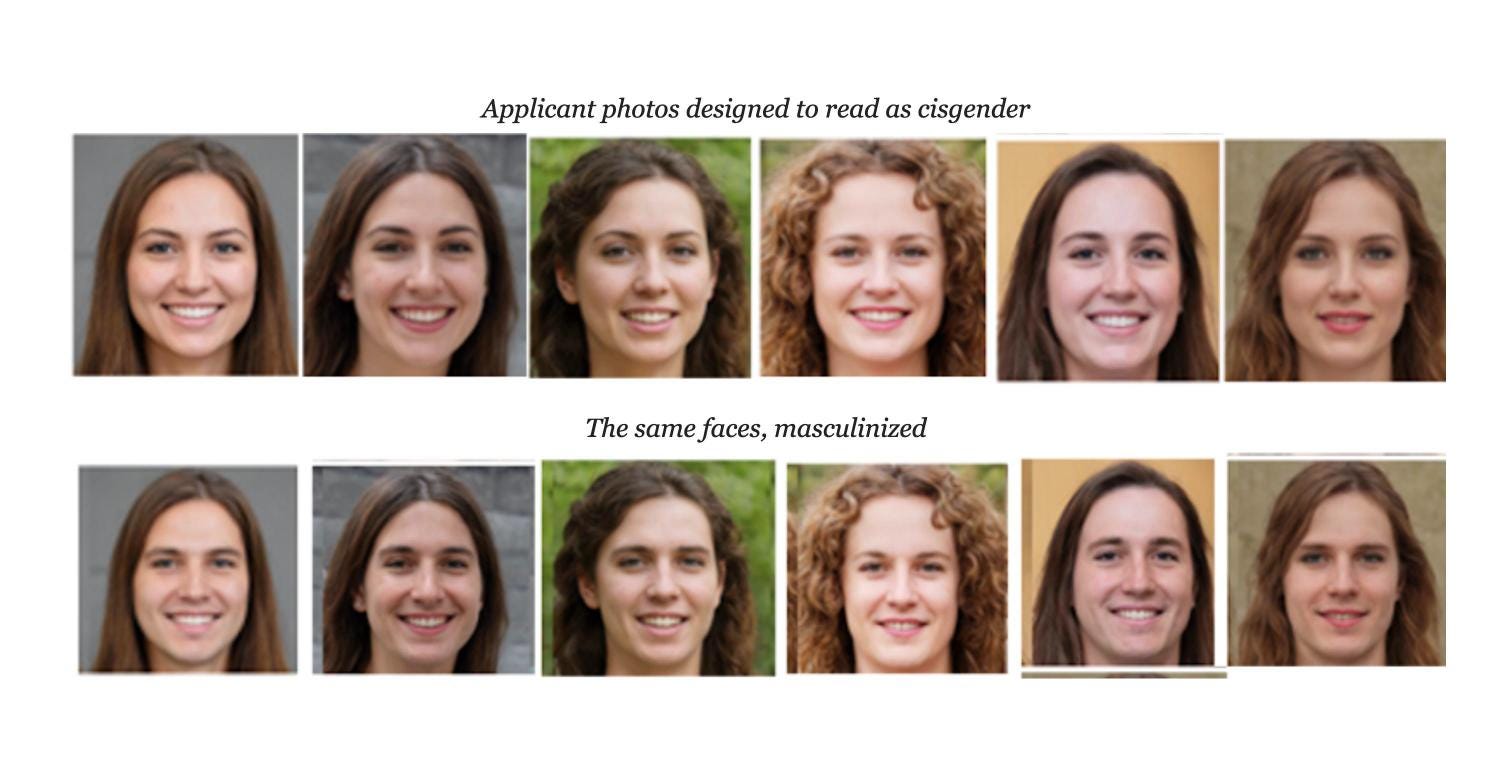
Eames also independently varied whether the application revealed a trans history, through evidence that the applicant had previously had a male name. The result was essentially a four-way experiment: women who passed with no disclosed trans history; women who passed but whose trans history was revealed; women who did not pass but made no disclosure; and women who both did not pass and disclosed that history.
Presumed cisgender candidates received a positive response to 47.6 percent of their applications. When a more masculinized image was included, the positive response rate dropped to 43.0 percent. A similar decline, to 43.5 percent, was seen when someone’s trans status was revealed within the résumé but the accompanying photo was cisgender-passing. When the non-passing picture was accompanied by the revelation of a trans history, however, positive response rates dropped by fifteen points, to 32.4 percent, suggesting that the two penalties compound each other.
The disadvantage associated with a non-passing appearance was further magnified when the posting listed a contact person with a male name, when positions were customer-facing, and when the image was more strongly masculinized.
It is already well established that trans people experience substantial economic disadvantage compared with their cis counterparts, including higher levels of unemployment and lower earnings. There are numerous potential contributors to this, including concomitant mental health challenges that may affect educational achievement or contribute to disability.
Eames’s study isolates the discrimination itself. With otherwise identical applications, trans women, and in particular trans women who bear more obvious signs of masculinization, are more likely to be screened out early in the hiring process. Before a trans woman has even had the chance to demonstrate whether she is competent, personable, or good at her job, simply being perceived as trans can reduce her chances of getting through the door. While this paper looked solely at the impact of facial passability on receiving a callback, the effect would likely extend to other characteristics that reveal a trans history, such as a deeper voice, which may become evident during a phone or online interview.
This creates a profound and vicious economic cycle. A trans woman who is already struggling financially may be unable to afford the interventions that could make her trans history less immediately apparent. If being visibly trans then reduces her chances of obtaining better-paid employment, the very economic disadvantage that prevents her from accessing those interventions may help perpetuate that disadvantage. The stresses of downward economic mobility, combined with the challenges of navigating the world as a trans woman, can lead to worsening mental health, further decreasing competitiveness for employment and increasing the likelihood of long-term unemployment, deepening poverty, and increased dependency on the state.
The state has a well-established interest in providing assistance to people who face modifiable barriers to obtaining employment, helping them become more employable so they can re-enter the workforce. Governments already make considerable investments in physical rehabilitation, mental health support, vocational retraining, wage subsidies, and employment-support programs. Non-passing trans women may face an unconventional barrier to employment, but, as Eames demonstrates, it is both real and consequential. It is also a barrier that is modifiable, most notably through interventions like facial feminization surgery and voice training.
We know that FFS is highly effective at helping non-passing women be perceived as female. A 2020 study in the Aesthetic Surgery Journal found that FFS raised the share of viewers who identified a trans woman’s face as female from 57 percent before surgery to 94 percent after. While facial feminization surgery is often framed as cosmetic, given Eames’s findings, it may have economic benefits as well. A 2026 cost-effectiveness analysis in Plastic and Reconstructive Surgery estimated that FFS costs approximately US$44,000 per quality-adjusted life-year gained, the standard unit health economists use to compare treatments, which is well within conventional U.S. thresholds for cost-effective health care. The same analysis notes that FFS is the most commonly denied gender-affirming procedure. The cost-effectiveness may be even more pronounced when considering the indirect benefits of improving employability.
A number of U.S. states currently cover FFS under their Medicaid programs, and many private insurers have extended this coverage as well. But coverage for FFS lags behind coverage of hormone therapy and bottom surgery. Collecting the economic data necessary to demonstrate the impact of FFS on subsequent employment and earnings may help build support for broader coverage in jurisdictions where it is not currently insured.
Eames suggests in her paper that among the solutions to this discrimination is to help potential employers recognize “a broader range of appearances as compatible with womanhood”; in other words, to overcome their prejudices against trans women, and to hope their customers are willing to do the same. While this is a reasonable aspiration, eliminating appearance-based biases against trans women would seem to be a long-term project.
More importantly, Eames acknowledges in the paper that “timely access to hormone therapy, voice therapy, surgery, and, where clinically appropriate, puberty suppression may reduce characteristics that make passing difficult.” Targeted interventions to improve passability and presentability should not be seen as merely cosmetic, but as practical and pragmatic interventions to improve the economic outlook of trans women.
Laura Targownik is a gastroenterologist and professor of medicine at the University of Toronto. She writes Data Driven Transsexual on Substack. Taryn Eames reviewed a draft of this essay for accuracy and supplied the images, which are drawn from StyleGAN2’s pre-generated headshots (license) and altered for the study. The author used AI tools for background research, copy editing, and checking references; the text is her own.
15% lower response rate. And that’s just to get in the interview process.
This is like the trans ban bullshit
https://thistleandmoss.com/p/they-know-better-the-cock-weasels-seized-press-badges-sacrificed-trans-kids-a-hostage-car-and-a-demo#queerisms-where-are-we-today