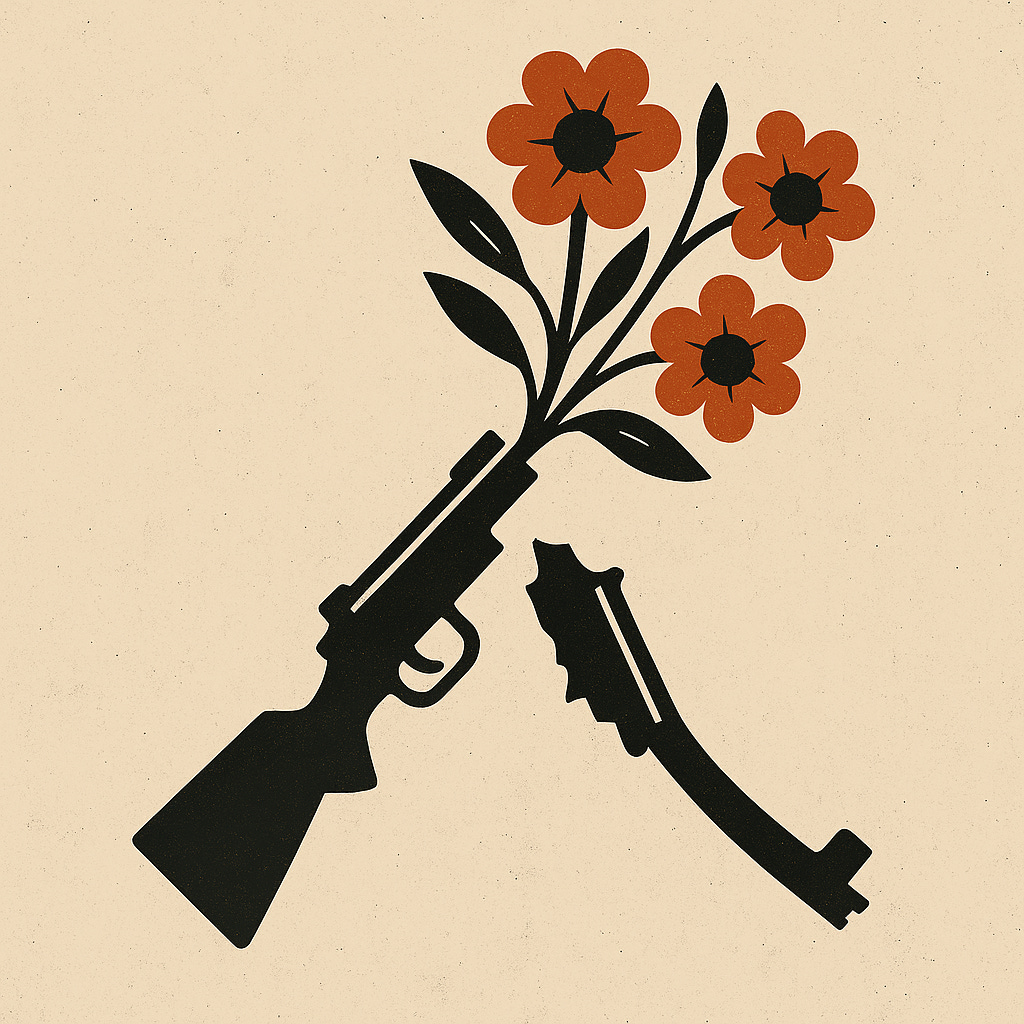
Seeing a life taken on video should shock and horrify us. It should never entertain us. And it points toward an underrated truth: pacifism in government is not naïve, but necessary. When leaders make violence taboo—when they insist that killing is shocking and unacceptable—they make all of us safer. When they fail, violence seeps into everyday life. Their horror at the assassination of Charlie Kirk is not just about the violence. It is the horror of elites recognizing the public they created.
For a generation, American political life has been conducted in a haze of death. Children gunned down in classrooms. Concert-goers massacred in Las Vegas. Grocery stores, churches, synagogues, parades. The cycles are always the same: shaky cellphone footage, breaking-news chyrons, candlelight vigils. Then the return to business as usual. Politicians perfected the performance of grief, the recitation of “thoughts and prayers,” and then moved on. Each repetition made the violence less outrageous. A permanent backdrop.
The pandemic deepened this numbness. Leaders downplayed the danger, mocked masks, and urged people back into crowded workplaces even as hospitals filled. Conservative media in particular pivoted to framing death as inevitable—“everyone’s going to get it eventually”—or even desirable, the supposed price of keeping the economy humming. One million Americans died of Covid, and the political response was not transformation but resignation.
And abroad, American weapons continue to flow into wars that kill civilians by the thousands. In Gaza, entire neighborhoods have been reduced to rubble by munitions stamped Made in the USA. Images of flattened hospitals and lifeless children are brushed aside with euphemism: “unfortunate,” “complex,” “tragic.” Our government signals, again and again, that death at scale is regrettable but permissible. What does that teach us about the value of life?
We live in a society where sex is taboo but violence is normal. That inversion tells you everything about what our politics fears, and what it tolerates. And you can see it in the roll call of political attacks we’ve already lived through: the shooting of Gabby Giffords, the shooting of Steve Scalise, the assault on Paul Pelosi, the attack on Donald Trump, the assassination of two Minnesota state lawmakers earlier this year, and now the assassination of Charlie Kirk. Each slightly less shocking than the last. Each captured in sharper, higher-definition video than the one before.
The repetition erodes our capacity for shock. What should horrify us becomes familiar. Smartphone footage circulates, algorithms amplify, and the spectacle of violence blurs into the churn of entertainment. The very act of watching—again and again—becomes a kind of permission.
The new elites must learn why the old elites had their rules. The postwar generation grew up in an era of hard-won political restraint, built by people who knew what it meant to lose friends and loved ones on the battlefield. They built guardrails to preserve peace because they had lived through its absence. Today’s leaders, raised in stability, treat those restraints as optional—and in doing so, they invite the return of horrors their predecessors worked to banish.
There’s an underrated argument for pacifism in government that runs straight through this moment. We tend to imagine pacifism as soft, a refusal to engage with a violent world. But pacifism is not only a refusal of war—it is a cultural safeguard. When a society makes violence taboo, when governments treat killing as shocking and rare, that taboo protects everyone. It makes violence harder to justify, harder to spread, harder to imagine as normal.
Every time a government normalizes violence—whether by shrugging at mass shootings, minimizing pandemic deaths, or justifying bombardments abroad—it lowers the social cost of violence. It teaches citizens that death is a tolerable outcome, a regular part of politics. And when people learn that lesson, some of them will apply it at home.
The work of a pacifist government is not only to protect its citizens from attack, but to preserve the taboo itself. To insist that violence is never entertainment. To refuse to treat mass death as background noise. To model what it looks like to be horrified, and to act accordingly—whether that means banning assault weapons, investing in public health, or cutting off arms sales to wars of extermination.
Because when horror fades, when the sight of a killing becomes just another clip in the feed, the door opens to everything else. We live in a time when conspiracy theorists upload shooting footage for likes, when presidential candidates joke about executing rivals, when extremist politicians wink at civil war.
The truth is that America has not suddenly entered a violent new era. The truth is that violence has been normalized for years, as a price of power and profit. What is new is that those who encouraged that normalization now see its reflection staring back at them.
The danger is not only that violence will escalate. The danger is that we will forget to be horrified.