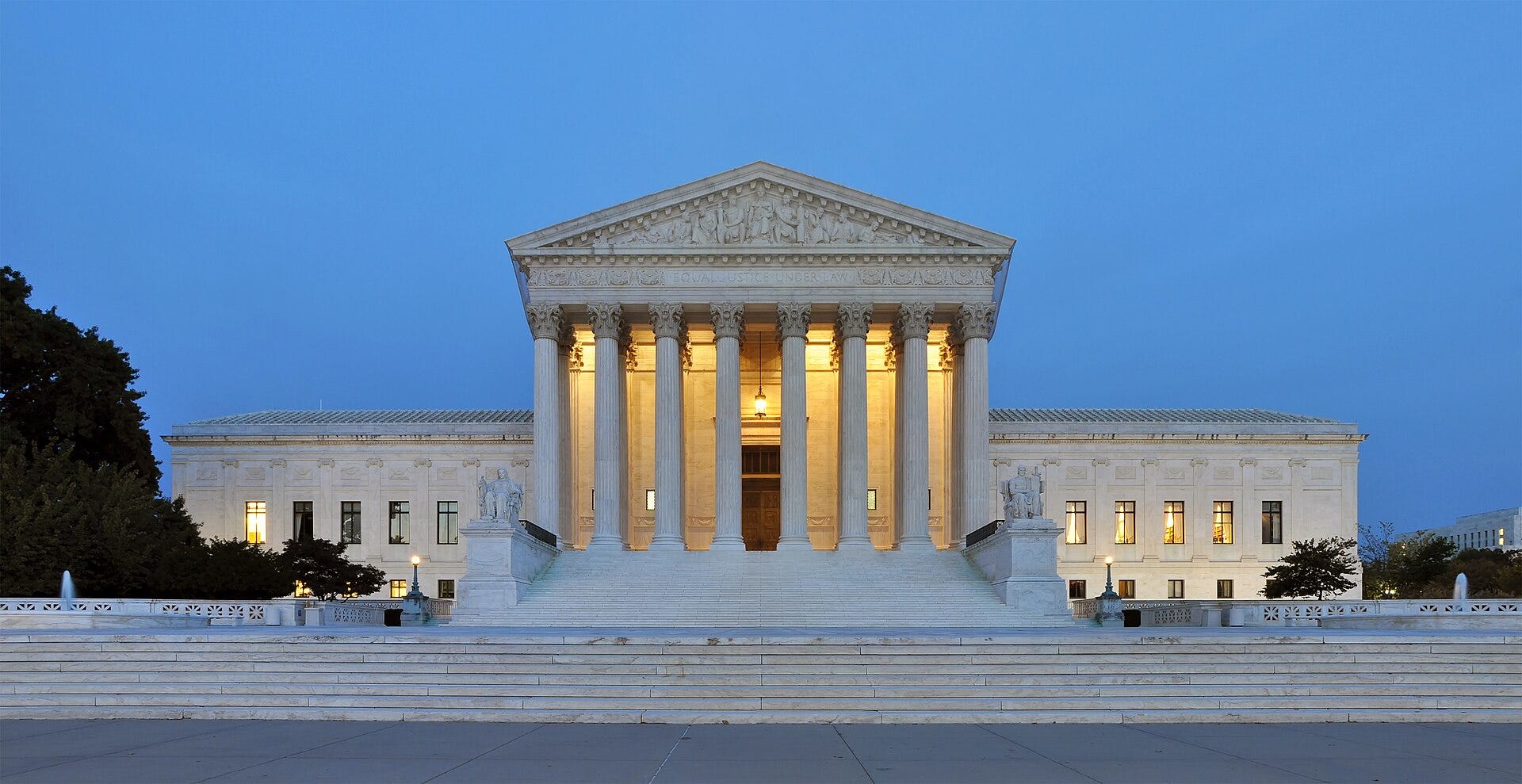
On Wednesday, the Supreme Court refused to let the Trump administration take transgender people in federal prisons off hormone therapy while it appeals a judge’s order blocking the policy. The order is two sentences long and gives no reasons, and only Justices Clarence Thomas and Samuel Alito said they would have granted the request.
The New York Times called it “a rare example of the conservative-dominated bench siding, at least temporarily, with the rights of transgender individuals.” The order is not a ruling on whether the policy is legal.
In February 2025, I wrote that state and local officials should sue the federal government over trans prisoners, because suing to “ensure continued medical care is a necessary step in preventing state-sanctioned abuse.” Prisoners brought this case themselves, with lawyers from the ACLU, the ACLU of D.C. and the Transgender Law Center.
The attacks on Harris
During the 2024 campaign, Trump attacked Kamala Harris over care for trans prisoners. In their September debate, he said she “wants to do transgender operations on illegal aliens that are in prison.”
His ads accused her of backing “taxpayer-funded sex changes for prisoners,” and one told viewers, “Kamala is for they/them.” In the first half of October alone, his campaign spent more than $19 million to air two such ads nearly 55,000 times, CBS News reported, citing the ad tracker AdImpact.
Fox News host Bret Baier played part of one of the ads for Harris on Oct. 16, 2024, and asked her about it. “I will follow the law,” she said, adding, “And it’s a law that Donald Trump actually followed.”
Now Trump’s own Bureau of Prisons is in the same bind. A federal judge has ordered it to keep providing gender-affirming care for now, and on Wednesday the Supreme Court refused to let it stop while the administration appeals.
What the policy does
On his first day back in office, Trump signed an executive order barring federal money for any treatment meant to change “an inmate’s appearance to that of the opposite sex.” The Bureau of Prisons issued two memos carrying it out that February, and in June 2025 U.S. District Judge Royce Lamberth blocked them.
The bureau has treated gender dysphoria with hormone therapy “since at least 1992,” the prisoners’ lawyers told the Supreme Court. To carry out Trump’s order, they wrote, the bureau “mandated the cessation of treatment for almost 1,000 people in its custody.”
On Feb. 19, 2026, the bureau replaced the memos with a new policy, Program Statement 5260.01. Under it, the bureau “will not provide hormones” to anyone not already on them and will put everyone else on a “tapering plan.”
The policy says a first tapering plan may not always end hormones, for example for people who have had surgery. It also says those plans “should be reevaluated regularly with respect to cessation of hormones.”
The policy ends transition-related surgery and says the bureau will, “when practicable, remove or confiscate” items like wigs and makeup. In place of hormones, it offers therapy, counseling and psychiatric drugs, according to the government’s emergency request to the Supreme Court.
The policy says Trump’s executive order “supports” it, but that the bureau “also adopts this policy independently” of the order. The sentence before that says the bureau “will comply with this Executive Order” unless a court blocks it.
Lamberth blocked the new policy on June 17, 2026, writing that it “is a near total ban on gender-affirming care.” He gave three reasons it was likely unlawful, including that it “does not follow from the evidence in the record.”
His third reason was that the bureau’s stated reasons were likely a pretext. It was “more likely,” he wrote, that “the government disregarded significant evidence in its possession to reach the [executive order’s] mandated result.”
Lamberth wrote that he was deciding only whether the bureau followed “mandatory administrative procedure,” and he left the prisoners’ constitutional claims “for another day.” He also wrote that the court had “no intention of wading into the culture war being waged against transgender individuals.”
The security argument
The bureau’s memo explaining the 2026 policy says that a prisoner on hormones faces an “increased risk” of “becoming a target for attacks.” It also says the care can “breed resentment among other inmates,” and that it conflicts with “a reasonable practice of refusing to reward threats of self-harm.”
Lamberth wrote that he did not “discount the possibility” that “a highly feminized transgender woman faces threats to her safety in a men’s facility.” But he found that the government “has not cited a single instance of gender-affirming care giving rise to safety concerns despite having provided such care for many years.”
His earlier order had been in place for more than a year, he noted, and the government offered no evidence that the care had caused safety problems during that time. In September, a divided panel of the federal appeals court in Washington wrote that the bureau makes claims about security “without addressing whether such issues have occurred.”
Before the Supreme Court, the government argued that courts should defer to prison officials on security. It said the bureau drew on its “experience and expertise,” including staff time spent finding “appropriate cellmates” for prisoners who appear feminine.
The medical argument
The government calls hormone therapy one of the “sex-rejecting interventions.” It says the bureau’s old rules “unreasonably relied” on standards from the World Professional Association for Transgender Health, which it says have been “cast into serious doubt.”
Lamberth disagreed, in findings the government says relied almost entirely on evidence outside the record the bureau put together. The government’s “attacks on the WPATH standards of care” cannot “overcome decades of research and clinical experience demonstrating the efficacy of gender-affirming care,” he wrote.
To show a medical debate, he wrote, the government pointed “primarily to caselaw and the declaration of a single medical expert with little experience treating gender dysphoria.” The expert, a psychiatrist, testified in another case that he had treated “around 6 to 8 adult patients with gender dysphoria” out of “approximately 20,000,” the opinion says.
Lamberth also noted that the same expert had admitted there is no evidence that psychotherapy works to treat gender dysphoria. The bureau’s own medical director, he wrote, has acknowledged that psychiatric drugs treat co-occurring conditions, not gender dysphoria itself.
The government does not dispute that gender dysphoria can be serious, Lamberth wrote. Untreated, it “can cause significant distress including increased risk of depression, anxiety, self-harm and suicidality,” he wrote, quoting the prisoners’ medical expert.
What happens next
On June 17, 2026, the appeals court paused a short-term extension of Lamberth’s 2025 order, saying it appeared to be an “administrative injunction” without any “discernible legal basis.” Lamberth blocked the 2026 policy the same day, ruling on a request the prisoners had filed in April.
Under the Prison Litigation Reform Act, these early court orders against prisons, called preliminary injunctions, expire after 90 days. Lamberth renewed his in August, and the new one runs out in mid-December unless he renews it again.
When the appeals court refused in September to pause Lamberth’s order, Judge Justin Walker dissented. He argued that Lamberth “lacks the authority to reissue the 90-day preliminary injunction.”
The prisoners’ lawyers told the justices that the government has not made that argument. Lamberth noted that the bureau itself agreed in an earlier case that the 90-day limit does not stop a judge from issuing a new injunction.
The Justice Department told Newsweek that “this isn’t a final decision on the merits” and that it would keep “pursuing our appeal in the DC Circuit.” Briefing in that appeal is set to finish on Dec. 23, after the current order runs out.
For now, the bureau has to keep providing care as it did just before Trump’s Jan. 20, 2025, executive order. Li Nowlin-Sohl, an ACLU lawyer for the prisoners, called Wednesday’s order “a critical ruling for our clients and all transgender people in Bureau of Prisons custody.”
The passport case
Last November, the same court let the administration require passports to list the sex people were assigned at birth while a challenge to that policy goes on, saying the administration was “likely to succeed.” That case, Orr v. Trump, is still pending in a federal court in Massachusetts.
Wednesday’s order shows that this court does not grant every request the administration makes against trans people. Trans people should not assume the passport fight, or any of these fights, is already lost.