


A year and a half after trans people inexplicably became the central focus of the 2024 Presidential campaign - a campaign won by the candidate promising to end so-called transgender “mutilation” - three trans women made appearances on the red carpet at the Met Gala, heralds of a flailing moral panic and a kinder, more creative future.
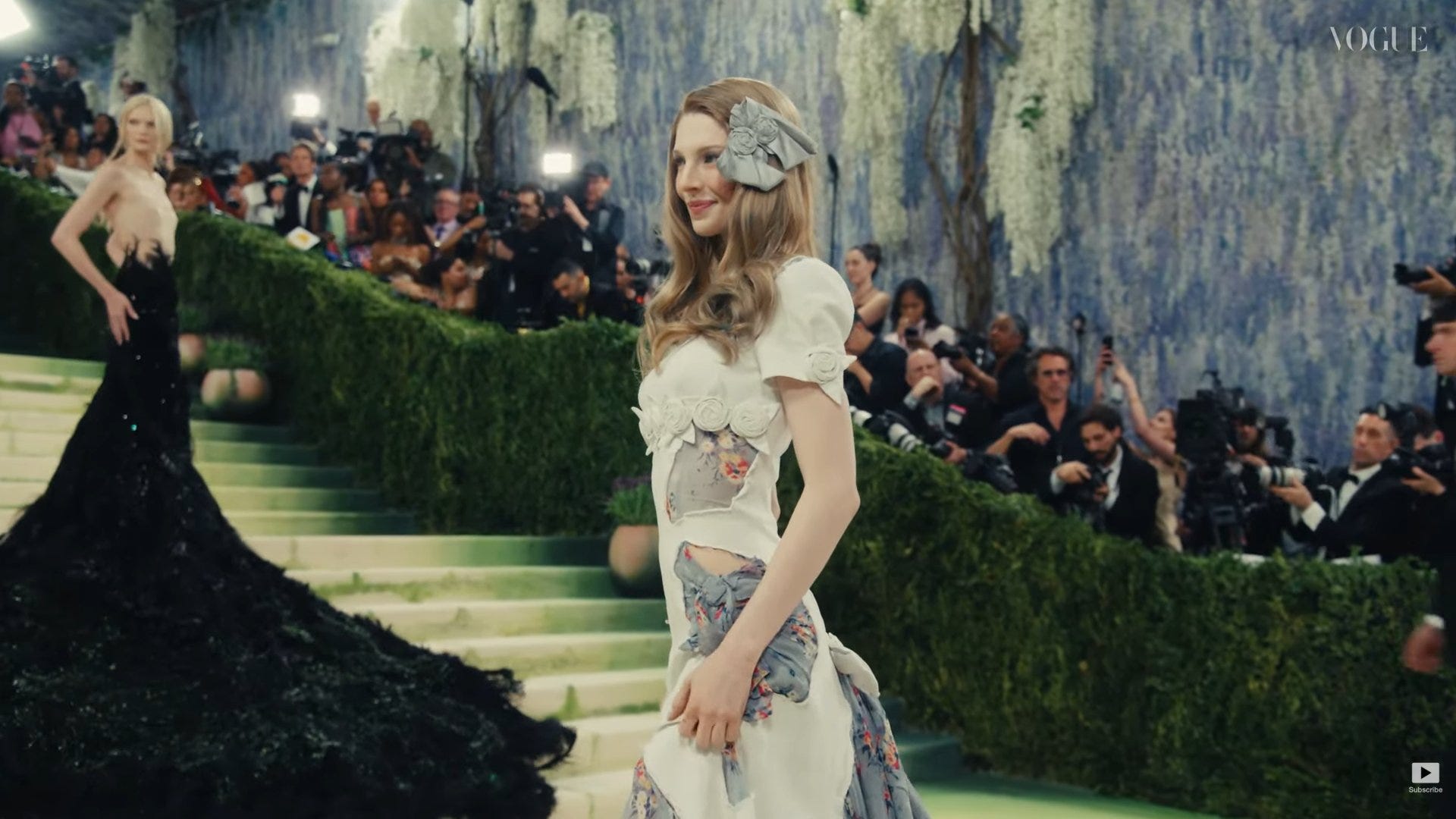
Euphoria actress Hunter Schafer wore custom Prada built around Gustav Klimt’s Portrait of Mäda Primavesi, the 1912 painting of a nine-year-old girl standing very still in a white dress with rosettes beneath the bust. The painting is one of Klimt’s portraits of his patrons’ daughters, and the girl in it has the upright, unsmiling presence of a child who has been told to hold still for the artist and is trying. Schafer wore the painting grown up. The empire waist and rosettes were preserved exactly. The dress itself was deliberately torn in long ragged cutouts that revealed floral silk chiffon underneath — a train of what was inside. W called the effect “Schafer as Primavesi all grown up.” The fashion reading is that the dress is aged, weathered, deteriorated by time. The other reading — the one I could not stop thinking about — is that the painting was made of a child, and the woman is what was underneath all along, and the cuts are how the underneath got out.
Model Alex Consani wore Gucci, by Demna, reportedly inspired by Botticelli’s Primavera — Spring, the painting where Venus stands in a meadow flanked by the goddess of flowering and the West Wind. Consani arrived in a long white faille cape and removed it on the carpet to reveal a sheer nude bustier and a black-feathered skirt and train. The cape was the move. She arrived covered in white and removed the cover and stood there in what was under it, by choice, in front of every camera in the city. She is the first trans woman on the Met Gala host committee. She said it was “a really special moment” and that she hoped to “set the conversation around expression and our bodies.”
Aariana Rose Philip wore custom Collina Strada by Hillary Taymour, a black gown built for her body and her chair. She is the first Black trans woman with quadriplegic cerebral palsy to attend the Met Gala, and the first wheelchair user — of any identity — to attend the Met Gala in its history. The second of those facts is the one most of the coverage led with, and it is the one that should be led with. The Met has been holding this event since 1948. It took until 2026 for the institution to figure out how to invite a person who uses a wheelchair to the steps. Philip told Vogue: “for so long, disabled people were not represented anywhere…To go from that to now, somehow finding myself there — I can’t say how blessed and honored I feel attending.” The honoring runs both ways. The institution that finally figured out how to open the door is also the one being honored, by a person who agreed to come through it on its terms.
The 2026 Met Gala theme was Costume Art. The premise of the show is that the dressed body is itself a medium — that fashion is a centuries-old art form whose canvas is a human being. That theme, in 2026, while the federal government is actively writing law about whose body counts as which kind of person, is not a neutral curatorial choice. It is one of those moments when the calendar produces a juxtaposition the institutions involved did not necessarily set out to make and then cannot un-make. Schafer’s body was offered as a reading of a Klimt painting; Consani’s body was offered as a reading of a Botticelli; Philip’s body was offered as the answer to a question about whose body the institution had managed not to invite for seventy-eight years.
I have spent my entire adult career arguing — sometimes for pay, sometimes in tweets, sometimes in research about the New York Times’s coverage of trans people — that visibility is not safety. That trans women being photogenic on a red carpet does not save trans kids in Tennessee whose families are losing them to forced outing laws. That representation is not policy. That what one trans woman in a designer gown does on the cover of Vogue does not, by itself, change the material conditions of any other trans woman’s life. I believe all of this. I will keep arguing it. The data on it has not moved.
And also, on Monday night, I was inspired.
The reason I was inspired is that I have never in my life seen three trans women arrive at a room like that one as if they belonged there. Not as the diversity hire on the host committee. Not as the brave breakthrough quoted in the soft-focus profile that the magazine ran to demonstrate its open-mindedness. Just there, dressed as art, taking the picture, being photographed by the same photographers and praised by the same critics and listed in the same best-dressed roundup that listed Beyoncé. The fashion press wrote about their dresses. The dresses were good. That was the entire story, on the surface.
If you have spent your life knowing that the room you are entering is going to do you damage on the way out, the experience of seeing other people who are like you enter the same kind of room and not get damaged is important.
I came up in a generation of trans women that learned to manage expectations. I learned, before I transitioned, the small daily practice of reading a room for hostility before entering it — the version of that practice available to a white, middle-class person who would eventually be able to pass, which is the gentlest version of it on offer. I learned, after I transitioned, that being recognizable as trans in public was — if I was not sufficiently careful about my voice or my walk or happened to cross paths with someone with a porn addiction and a guilt problem — a tax I could pay every time I left the house, and I learned the small daily craft of paying it without losing the entire day. The art of being in public as a trans woman, for most of us, has historically been the art of being in public less — of training the eye to not see you, of wearing the cut and color that doesn’t catch attention, of taking the seat at the back of the cafe.
What Hunter Schafer did on Monday night, and what Alex Consani did on Monday night, and what Aariana Rose Philip did on Monday night, was the inverse of that art. They moved toward the cameras. They wore the cuts that were designed to be looked at. They were art — they had volunteered, with the Met’s collaboration, to be art — and they collected the looking that art collects. There were no apologies in any of the three dresses. There was no managing. There was nothing said with any of the three bodies that meant please do not see what I am. There was a great deal said with all three bodies that meant look.
I am thirty-five years old. I have been a trans woman in public for something like eight years. The number of trans women in human history who have taken a room the way the three of them took those steps is vanishingly small. The political claim — that representation does not equal liberation, that one trans woman on a host committee does not undo the legislative damage being done to trans children by the same institutions that find trans women acceptable when they are dressed by Gucci — that claim is true, and I have written it many times, and I will write it again. But the cost of being a trans woman in public, paid daily by the trans women who do not get the Gucci cape, is not separately measurable from what the Gucci cape is for. The cape says the room can hold this. The cape says, to the next girl who is about to enter a worse room: there is a way of standing in public in which your existence does not require an apology.
I do not believe that way is universally available yet. I know it is not. But I have spent enough of my life apologizing for taking up space to recognize the difference when I see it.
The dressed body in public is always making a political statement. The question is whose body, and what room they are standing in. In January 2025, Lauren Sánchez stood next to her husband Jeff Bezos in the Capitol Rotunda at Donald Trump’s second inauguration, in a white Alexander McQueen pantsuit with a white lace bra showing through the open blazer. She later told The New York Times she was “super proud” of the look. The criticism she received was about taste. It was not about whether she belonged in the room. The room — the Rotunda, the inauguration, the front row of the new presidency — was hers, on her billionaire husband’s seat, behind the man whose first executive orders would target trans people for federal exclusion. She wore the kind of revealed body that no trans woman in this country could wear in that room, on that day, and survive professionally. She did not have to think about it.
Four months later, on the Met Gala steps, Alex Consani wore a sheer bustier under a cape she removed in front of the cameras. The visual move is similar. The political stakes are not. Consani was not standing behind power on the day power renewed its right to write trans women out of public life. She was standing on the cultural pinnacle in the year power was trying to do exactly that. The body in the dress was making a different argument because the room was different.
In the months since Trump’s second inauguration, the federal government has issued executive orders that govern whether a trans person can update a passport, board a plane, hold a federal job, or use a public restroom in a federal building. The conditions of trans life are not improving. The country we live in is not improving.
And on Monday night, three trans women arrived at the most photographed room on the continent and were beautiful in it, and the photographers took the picture, and the magazine wrote it up the way it would have written up anyone, and the dresses really were good, and Hunter Schafer was the painting all grown up, and Alex Consani took the cape off, and Aariana Rose Philip arrived at a building that had not, in seventy-eight years, figured out how to invite her.
I am allowed to want both of those things to be in the same sentence. I am not required to choose between them. The political analysis stands. The cape is also the cape.
Three years ago I wrote a report at Media Matters about Michael Knowles, Matt Walsh, Candace Owens, and the wave of right-wing commentators who had begun, openly and on camera, calling for the elimination of transgender people from public life. Knowles told a CPAC audience in 2023 that “transgenderism must be eradicated from public life entirely.” This terrifying pronouncement was defended by Senator Mike Lee and other federal officials. At the time, I argued that there was no distinction between the concept of “transgenderism,” and that Knowles was making a genocidal statement.
I was partly right at the time, and partly wrong. I was right that the people running the rhetoric were after trans people, not an abstraction; the federal executive orders of the last four months prove it. They are not aimed at an idea of transgenderism. They are aimed at the passports and the bathrooms and the jobs of people I know.
But there was also an idea those men were after, and they have not been able to eradicate it. They will not be able to eradicate it. The idea is what Hunter Schafer was wearing on the steps of the Met. The idea is the cape Alex Consani took off in front of every camera in the city. The idea is the ramp Aariana Rose Philip got the institution to build for her. You can write executive orders against the bodies. You cannot write executive orders against the idea of Hunter Schafer in a Klimt dress — the painting all grown up, the cuts that let the underneath out.
I do not know what the Met Gala does for the seventeen-year-old in Tennessee whose parents are about to be informed by her school that she has asked her teacher to call her by a different name. The honest answer is probably nothing. The honest answer is probably that one beautiful image on a phone screen in a bathroom at school is a thin shield against a state.
But shields have been thinner. The girls who came before me did not have the Met Gala. They did not have the cover of Vogue. They did not have the chance to look at a photograph of a woman who was like them being praised in the same paragraph as Beyoncé. The thinness of a shield does not negate that it is one. The seventeen-year-old in Tennessee will, on Tuesday, see that picture. So will the eight-year-old in Mississippi. So will the disabled trans kid in any of the fifty states whose first thought on seeing Aariana Rose Philip on the steps was that is the first time I have seen what I will look like in my own life. So will the woman in her late forties who has not yet told anyone, who has been holding a feeling like a held breath for thirty years, who will scroll past Hunter Schafer in the Klimt dress and feel something she does not have a word for.
The political conditions do not change because of a dress. The interior conditions of the people the political conditions are aimed at sometimes do.
I did not meet an out trans woman until I was twenty-eight years old. By then I had already come out. The thing I had to figure out about my own life, I had to figure out without seeing it lived in front of me. There were trans women in the world — there had always been trans women in the world — but the part of the world I had access to, growing up where I grew up, with the people I grew up around, did not contain any of them. I assembled a future for myself out of books and the internet and the small flashes of recognition I got from rumors of other people’s lives. The work was uphill. It is hard to describe how uphill it was, because the difficulty was made of an absence, and absences are difficult to point at.
The kid in Tennessee on Tuesday morning will start the same imagination work in a room where it has been done first by people who are now on the steps of the Met. The work will still be uphill. The state she lives in will still be hostile. The federal government will still be writing executive orders aimed at her. But she will be doing the imagination work in a world that contains a photograph of Hunter Schafer in the Klimt dress, and a photograph of Alex Consani removing the cape, and a photograph of Aariana Rose Philip at the top of a ramp she got the institution to build for her. None of those photographs existed for me. All of them exist for her.
Three women on Monday night put a marker of public dignity for trans people on the steps of the Met. They did not put it everywhere. They put it there. It is a real place. A child who is currently at war with her own image will, eventually, see what they did, and the war will not end, but the terms of the war will have changed, because the kid will have seen a thing that previously did not exist for her to see.
Don't forget about Lux Pascal! She was there.
I love this article, genuinely, but as a trans person it feels a little weird that while you repeatedly say "trans people" you never mention any of the other trans people who showed up. I know it wasn't your intention but by not mentioning these other trans people and repeatedly treating trans women and trans people as interchangeable terms, you're erasing other trans people. You don't have to focus on them or anything, but you could have at least acknowledged that there were other trans people there.