


Last Thursday evening, nine days after he won his primary by thirty points, Senator Ed Markey of Massachusetts posted a sentence he had been saying all summer: “In Massachusetts, we have a responsibility to protect the vulnerable and stand up for those who need it. We don’t throw trans kids under the bus for political points.” He didn’t name anyone, and he didn’t need to. The night before, James Talarico, the Democratic nominee for Senate in Texas, had told Fox News that he would oppose trans athletes in girls’ sports if it endangered “safety or fairness,” and by Thursday morning a lot of trans people online were saying the same thing about him.
Markey had earned those words. He spent the summer saying that Seth Moulton threw trans kids under the bus, said it to his face in August, and won 65 to 35 on September 1. Moulton had blamed us for a presidential election in the New York Times. Talarico had said “trans athletes” and “safe and fair” on Fox News. I don’t think those two men did the same thing, and I don’t think we should be using the same words for both of them.
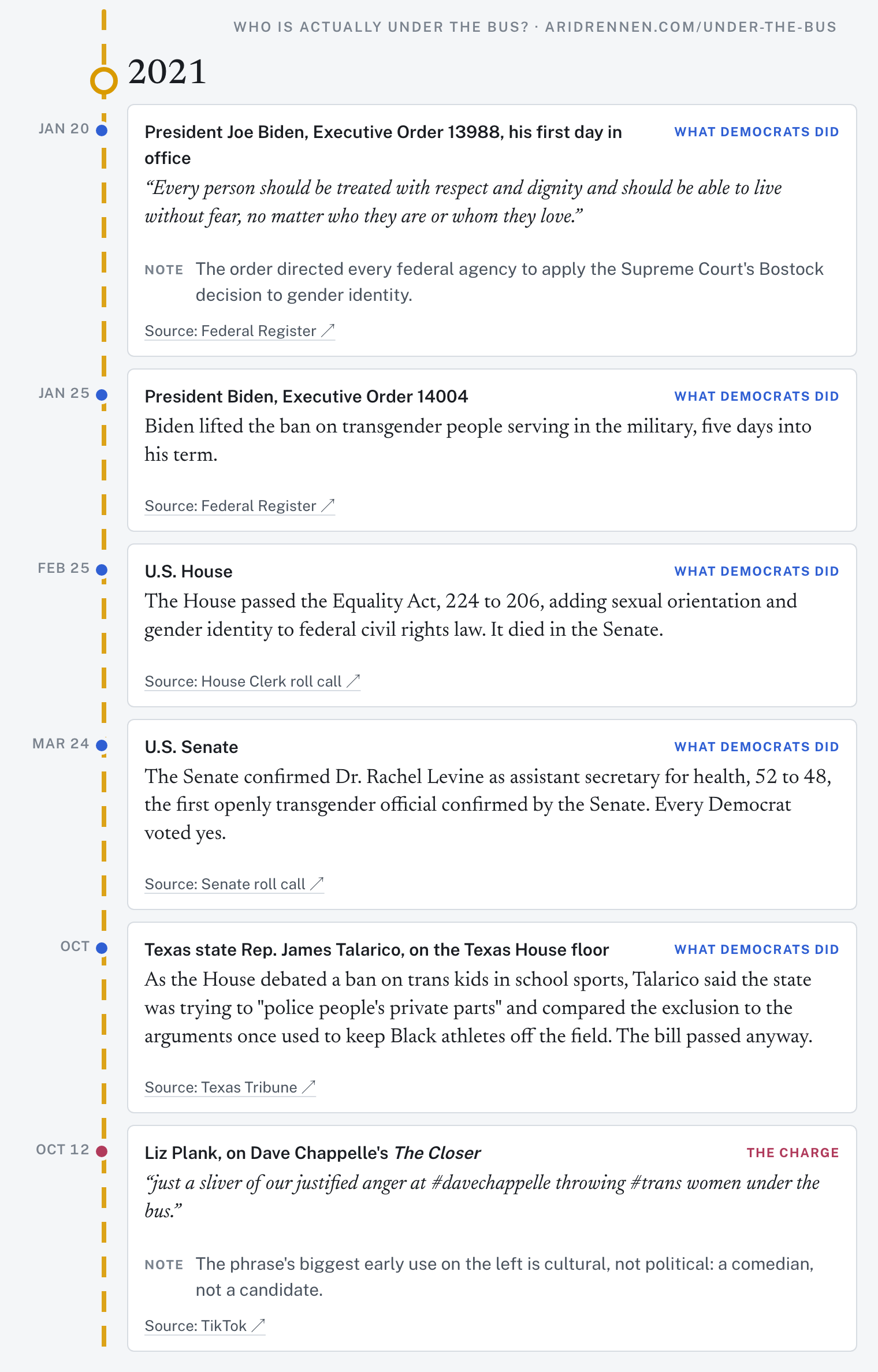
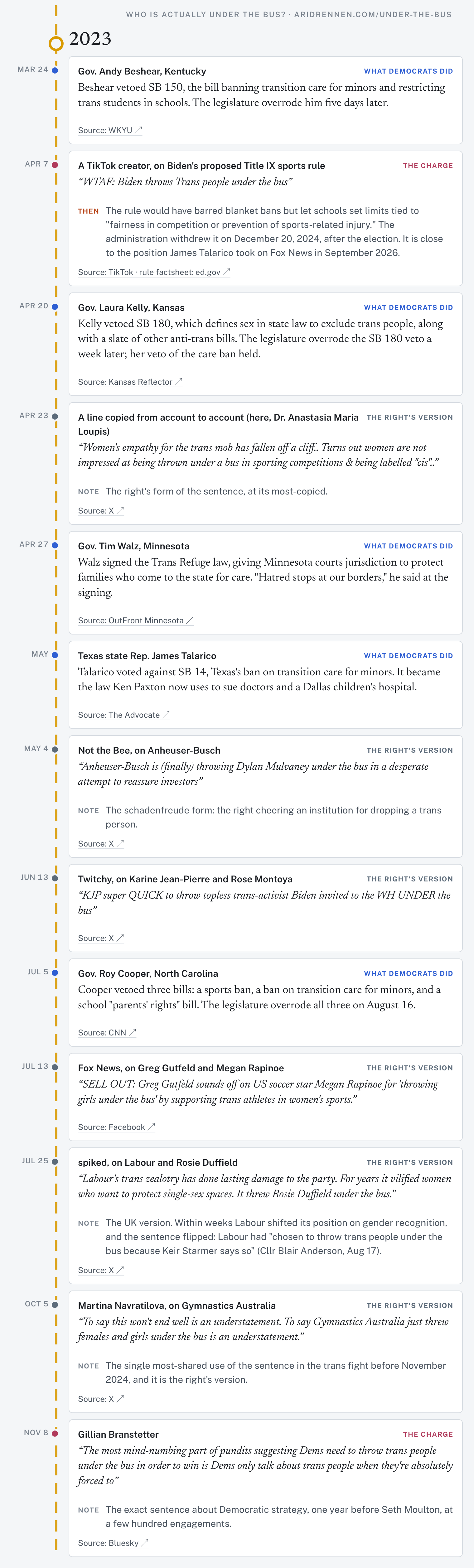
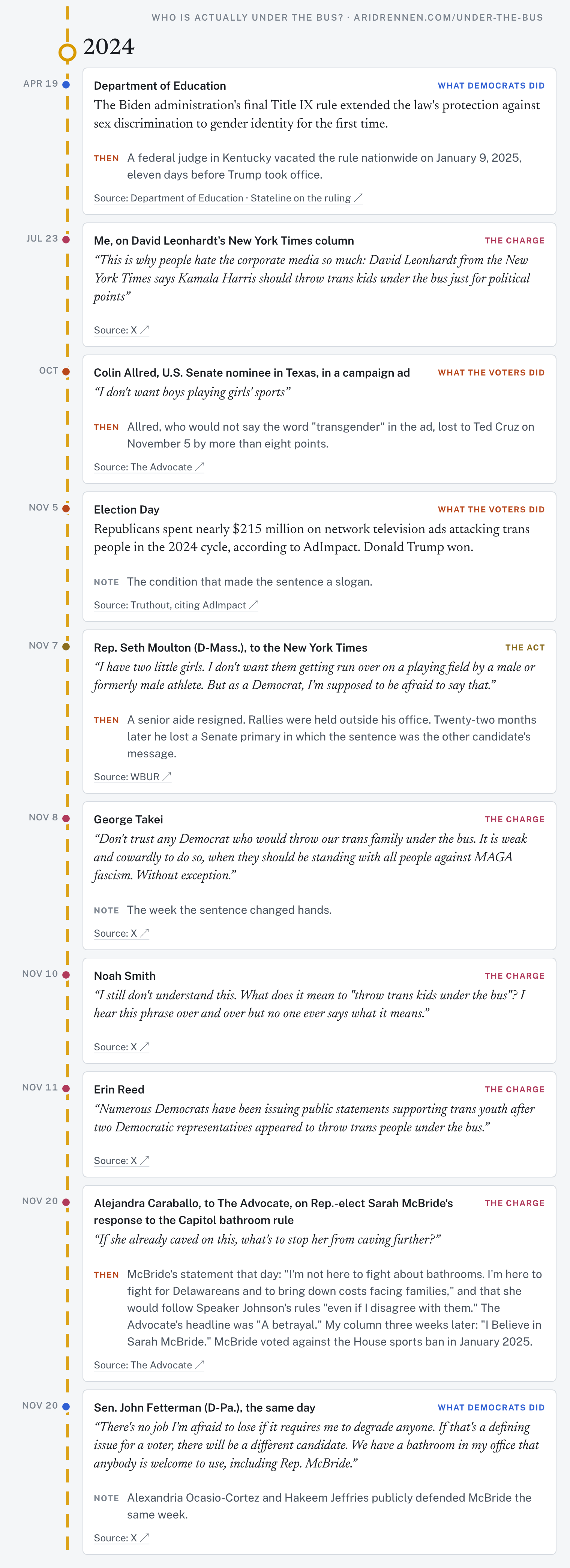
I’ve said it too. In July 2024 I tweeted that David Leonhardt of the New York Times “says Kamala Harris should throw trans kids under the bus just for political points.” Fourteen months later I was tweeting that I was “tired of hearing assertions that Democrats ‘threw trans people under the bus’ in 2024 from people whose primary interest in the trans community is as cannon fodder for their revolutionary pipe dreams.” I still believe both of those things, and I think the gap between them is the problem: we now use the same six words whether or not the person we’re talking about has actually done anything to us. So I went back through five years of people saying it and wrote down who said it, about whom, what Democrats were actually doing at the time, and what the voters did next. The full record is in the clickable timeline, with a source for every entry; the year-by-year version runs through this piece.
Who was saying it first
Let’s start with who was saying it before we were. It’s easy to forget that until November 2024, the people accusing someone of throwing someone else under the bus were mostly on the right, and the person they said had been thrown was almost always a woman. Martina Navratilova said it about Gymnastics Australia, the British magazine spiked said it about Rosie Duffield, and a line about women “not impressed at being thrown under a bus” got copied from account to account all spring. When Anheuser-Busch dropped Dylan Mulvaney, Not the Bee celebrated in the same words. That is who was using the phrase for most of 2023, and they were using it against us.
On our side, hardly anyone said it. Hillary Clinton told the Financial Times in 2022 that whatever doesn’t help you win shouldn’t be a priority, and a YouTube channel titled its episode “Clinton Throws Trans Americans Under The Bus.” After the 2022 midterms, Jeet Heer wrote that Matt Yglesias had urged Democrats to do it. When the Biden administration proposed a sports rule in 2023 that would bar blanket bans but let schools set limits for fairness and safety, a TikTok announced that Biden had done it too. None of those accusations went anywhere, and I think the reason is simple: Clinton wasn’t running for anything, and the Biden rule would have barred the blanket bans that the states were passing.
It’s also easy to forget what that administration actually did. It signed an order against gender identity discrimination on its first day, lifted the military ban five days later, confirmed Rachel Levine with every Democratic vote, and put an X marker on our passports. When Republican legislatures in Kentucky, Kansas, and North Carolina passed bans, the Democratic governors vetoed them and were overridden. Whatever else you want to say about those years, the Democrats who had the power to protect us mostly used it.

November 2024
Two days after the election, with Republicans having spent nearly $215 million on network television ads about us, Moulton told the New York Times: “I have two little girls. I don’t want them getting run over on a playing field by a male or formerly male athlete. But as a Democrat, I’m supposed to be afraid to say that.”
I understand why so many of us started saying it that week. Here was a Democrat blaming us for the loss two days after the polls closed, and George Takei wrote what a lot of us felt: don’t trust any Democrat who would throw our trans family under the bus. Noah Smith asked, not unreasonably, what the phrase was supposed to mean. Nobody really answered him, and looking back, I think that week is when the phrase stopped describing something Moulton had done and started being what we say whenever a Democrat disappoints us.
The same week, people started saying it about Sarah McBride, who told reporters she wasn’t there to fight about bathrooms and would follow the Speaker’s rules even though she disagreed with them. The Advocate’s headline was “A betrayal.”
I wrote then that none of us are obligated to die on the first hill they come across, that sometimes there’s better terrain nearby, and reinforcements waiting, and I still believe it. John Fetterman wrote the same day that there was no job he was afraid to lose if it required him to degrade anyone. She didn’t need to fight about a bathroom to keep her allies, and two months later she voted against the national sports ban along with every House Democrat but two.
2025
In 2025, Democrats started making it a promise. When Gavin Newsom told Charlie Kirk that trans girls in girls’ sports was “deeply unfair,” Erin Reed said he’d thrown us under the bus. Two months later Tim Walz stood up at the California Democratic convention, in Newsom’s home state, and said, “Shame on any of us who throws a trans child under the bus for thinking they’re going to get elected.”
By fall, the argument on the left about why we lost in 2024 was happening in the same words. Emma Vigeland wrote that Democrats had thrown trans people and immigrants under the bus and lost to a fascist, and Briahna Joy Gray wrote that anyone arguing we’d be safer if they had was “sick and dark sided.” That was the week I wrote my cannon-fodder tweet, because both sides of that argument were describing a party that had, in fact, spent the year voting with us.
Look at what that party was actually doing that year. In January the House passed a national sports ban with two Democratic votes, and in March it died in the Senate with every Democrat voting no. Fifteen Democratic attorneys general answered Trump’s order on our care within a week.
In June, McBride told Ezra Klein that what we’d been doing wasn’t working, and she was accused of throwing us under the bus for saying so. Erin Reed conceded the point I keep coming back to: “Democrats have largely held solid on transgender rights in recent years in terms of actual votes taken.” Two weeks later she warned that some Democrats were privately preparing to capitulate on our health care. The Medicaid ban fell out of the tax bill that same month, after McBride and Senator Tammy Baldwin led the challenge that got it ruled out of order, and the capitulation never came.
In November, Abigail Spanberger, who had been attacked all fall in ads about bathrooms and locker rooms, won Virginia by more than fifteen points. Charlotte Clymer’s summary on inauguration day was that Spanberger had been told to throw trans youth under the bus, refused, and won in a landslide.
In December, when Marjorie Taylor Greene brought a bill to the floor that would make our care a felony, McBride told reporters it “would have imprisoned my parents if I had come out just a little bit earlier,” and then worked the Republican side as a member of the whip team. Four Republicans voted no. The bill passed 216 to 211, and nine months later it has not become law. I don’t know what else we could have asked her to do.

2026
The Democrats who actually turned on us have started losing. In March, state Representative Nasif Majeed, the only Democrat who voted to override Governor Josh Stein’s veto of an anti-trans bill, lost his North Carolina primary 69 to 27. Michael Wray, who had voted with Republicans to override the sports and care bans in 2023, lost 64 to 36. Moulton carried his November interview into a Senate primary, apologized for it repeatedly, and lost by thirty points to a man who said those words all summer. A UMass Amherst poll found that 67 percent of Massachusetts Democratic primary voters were less likely to support a candidate who opposed transgender rights.
Colin Allred said “I don’t want boys playing girls’ sports” in the last Texas Senate race, wouldn’t say the word “transgender” at all, and lost to Ted Cruz by more than eight points. In the two years since Moulton’s interview, every Democrat I can find who lost over trans politics is one who turned on us.
Meanwhile Democrats in Congress have blocked every federal anti-trans bill from the minority. The January funding package went through with dozens of riders stripped, which McBride’s office credited her with working relentlessly with her colleagues to ensure. The Senate blocked a trans-athlete amendment 49 to 41 in March, and in July every House Democrat present voted against writing the military ban into law.
McBride said it herself in April: “not a single anti-trans bill or provision has become law. That’s not by coincidence, it’s by hard work and a strategic approach.”
Three Democrats will test all of this in November. Amy Acton, the Democratic nominee for governor of Ohio, told the Toledo Blade in June that she doesn’t support “boys playing in girls sports.” Talarico, who voted against Texas’s ban on our care in 2023, said “safe and fair” last Wednesday, which is close to what the Biden administration proposed in 2023 and quietly withdrew after the election without anybody organizing against Joe Biden over it.
Josh Turek, the Democratic nominee for Senate in Iowa, is the harder case. He won his primary in June by 25 points, and in July he told The Gazette that the question should be left to “the sports governing bodies” rather than Congress, “but I can tell you, as someone that spent a lot of my life in high-level sports, I don’t believe that biological men should compete against females in sports.” It bought him nothing. Elon Musk’s super PAC began running an ad in Iowa last week saying he “voted to spend our tax dollars on sex change surgeries for children,” a claim PolitiFact had rated False in June, and the next day his spokeswoman said that “Josh opposes taxpayer-funded sex changes, and anyone who says otherwise is lying.” By Thursday the phrase was aimed at him too.
Turek’s record in the Iowa House is a record of voting with us. He voted against the 2023 law that requires schools to tell parents when a student asks to use a different name, and against the 2025 budget that barred Medicaid from paying for our care. But “biological men” is Ken Paxton’s word and Elon Musk’s, not the one Talarico used, and a promise to oppose “taxpayer-funded sex changes” is a promise about our health care, not about who plays on a team. I don’t think Turek has thrown us under the bus yet, because he hasn’t cast a vote in the Senate. He has told us what he thinks we are, though, and what he is willing to give up, and that is more than Talarico did. Acton said “boys,” Turek said “biological men,” and Talarico said “trans athletes,” and I think those differences will matter more than any of the three campaigns expects. Ohio, Iowa, and Texas all vote on November 3, and I’d rather wait for the voters than decide now that all three of them have abandoned us.

Ask what they actually did
I know that not everyone in our community will want to hear this, and I understand why the phrase feels good to say. It’s short, it’s vivid, and the last two years have given us plenty of reasons to expect the worst from our allies. But it’s only true when a Democrat has actually done something to us. Moulton blamed us for a presidential loss, Majeed and Wray voted to override vetoes that protected us, and Allred would not say the word “transgender” at all. Those are real acts, and when we called them out, the voters backed us up.
It’s false when all it means is that a Democrat didn’t say what we wanted on Fox News. By that standard Biden, Clinton, McBride, and Talarico all threw us under the bus, and the phrase no longer tells us anything about any of them. Rhetorical softening is not the same thing as abandonment, and if we keep telling Democrats that it is, we should expect some of them to decide that they’ve already lost us and vote accordingly.
So the next time you see those words aimed at a Democrat, ask what they actually did. If they blamed us for a loss, voted to take something from us, or refused to say who we are, then say it, and say it loudly, because the record now says the voters will back you up. If they said “safe and fair” to a Fox News anchor while the other name on the ballot was the man who once asked the state for a list of us, then I’d save it. If they said “biological men” and let their campaign promise to oppose “taxpayer-funded sex changes,” as Turek did last week, then wait for the vote, because that is where the phrase will either become true or not. Ed Markey used those words against a man who had blamed trans kids for a presidential election, and Massachusetts Democrats agreed with him by thirty points. There will be another Seth Moulton, probably soon, and when he shows up we will want those words to still mean something. Let’s save them for him.
Fantastic article! Thanks for putting words to a feeling I've wanted to express!
People keep missing that qualifier phrase, "if it risks safety or fairness." Studies have shown that trans athletes in girls' and women's sports (let's be honest, the haters don't care about trans masculine athletes in boys' and men's sports) effects neither, so there's nothing for Talarico to be against.
I keep waiting for a politician to say, "Of course I don't want boys in girls' sports. Since trans girls are girls, though, we have nothing to worry about!"