


Democrats won the Senate and the House on Tuesday after Republicans spent nearly $400 million on anti-trans ads across TV and digital this cycle, according to the Transgender Freedom Alliance (TFA). In Senate races, James Talarico won in Texas, Adam Hamilton won in Kansas, and Sherrod Brown won in Ohio, so we’re about to spend a few weeks hearing what all of this means for trans people.
Some of those takes will say that Democrats won by running away from us, because the Democrats who agreed with Republicans got the headlines this fall. CNN reported in September that some Democrats were “mirroring the GOP message,” Newsweek ran a similar story, and I’ve written about those Democrats myself.
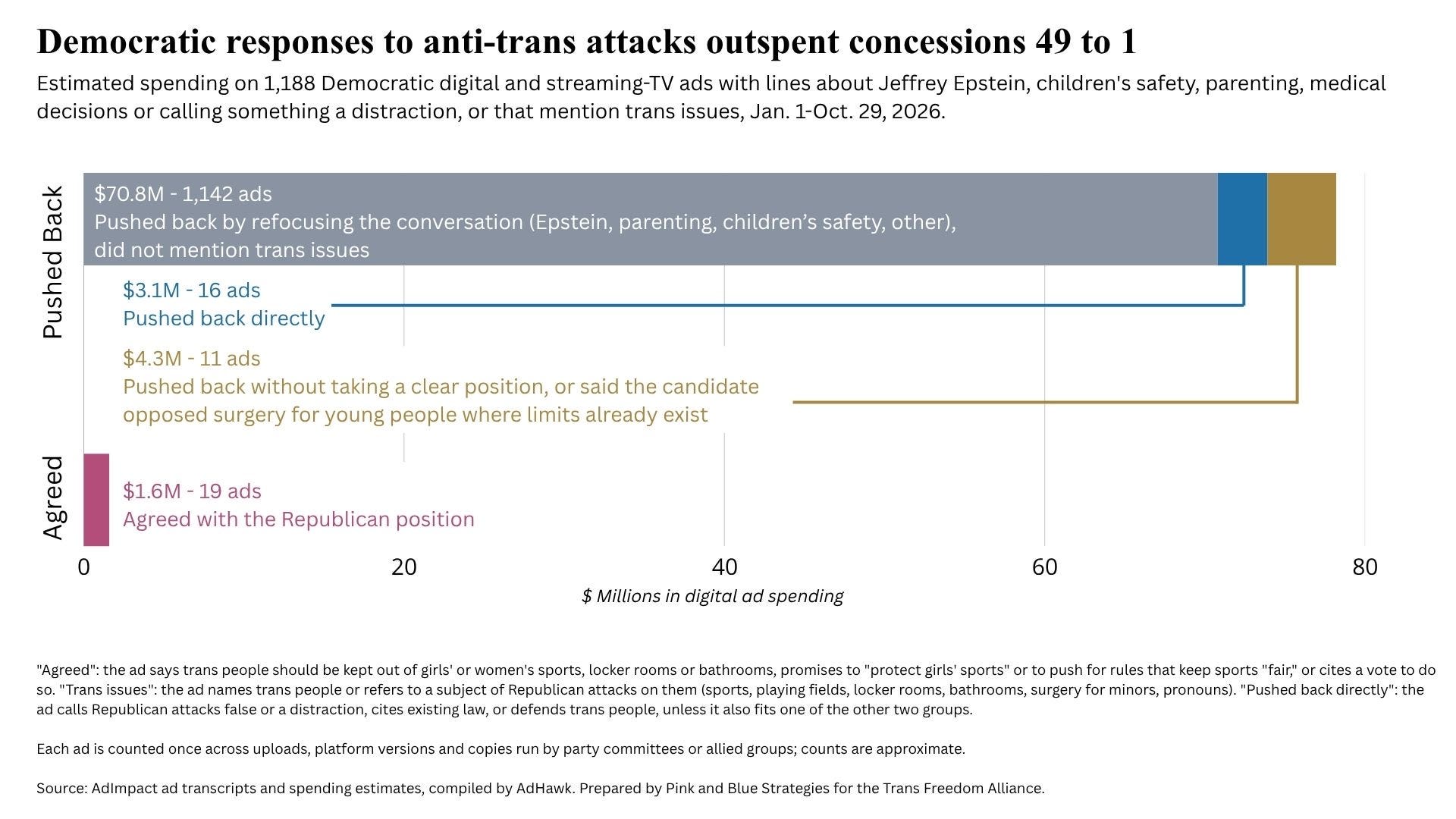
Those ads were real, and they were hard for us to watch, but they were a small part of what Democrats paid for this year. In the ad data my firm reviewed, the ads tracked as Democratic responses to anti-trans attacks outspent the ones that agreed with Republicans 49 to 1.
What the ads said
My firm, Pink and Blue Strategies, did this count for TFA, a group that researches how candidates can answer anti-trans attacks, and TFA sent the numbers to reporters on Monday. We used data from the ad-tracking firm AdImpact, compiled by AdHawk, a project of the Democratic group Priorities USA, and we counted each ad once, no matter how many times it was uploaded or copied.
That gave us 1,188 Democratic digital and streaming-TV ads from Jan. 1 to Oct. 29, with about $79.8 million in estimated spending. Each one either mentions trans issues or has a line about Jeffrey Epstein, children’s safety, parenting, medical decisions or calling something a distraction, which AdHawk tracks as ways Democrats answer or get ahead of these attacks.
Only 19 of those ads, with about $1.6 million in spending, agreed with the Republican position. That’s 2% of the money, and TFA counts the other $78.2 million as pushback of one kind or another, though most of those ads never mentioned us.
Let’s start with the 19, because those are the ones we all saw. Josh Turek, who won Iowa’s open Senate seat on Tuesday, ran an ad in October saying he opposes “males competing in female sports,” and Rep. Marcy Kaptur of Ohio ran one saying she “voted with Republicans to keep transgender ideology” out of schools.
Turek’s three ads of this kind had about $59,000 in digital and streaming spending, and Kaptur’s had about $40,000. The biggest spenders were Dr. Annie Andrews in South Carolina, with about $566,000 on one ad, and Sarah Trone Garriott in an Iowa House race, with about $531,000 on three.
The DCCC, the House Democrats’ campaign arm, also ran two of the 19 jointly with candidates, with about $187,000 between them. All of these totals, and the 49 to 1, leave out broadcast and cable TV.
Eleven of the 19 first ran on Oct. 20 or later, so the data only catch their first days. Every ad in this count that mentioned trans issues and started after Oct. 16 was one of those 11.
Most of the money never mentioned us
I don’t want to oversell this number, because most of these ads didn’t say a word about us. The biggest group, $70.8 million across 1,142 ads, ran on subjects like Epstein, parenting and children’s safety, and $55.5 million of it went to ads that mentioned Epstein.
TFA counts those ads as pushback because its research told Democrats to turn these fights back on Republicans, and its advice included going after them on child safety and the Epstein files.
Of the 46 ads that did mention trans issues, 19 agreed, 16 pushed back directly and 11 either took no clear position or said the candidate opposed surgery for young people where limits already exist. About $3.1 million went to the ads that pushed back, and all but about $4,300 of that was Brown’s, including about $1.33 million for an ad saying, “It’s against the law to perform transgender surgeries on kids.”
About $3.5 million of the $4.3 million in the last group was for Talarico. His campaign told Texans, “No, I don’t support sex change surgeries for kids.”
So the fair summary is that very few of these ads agreed with Republicans, and even fewer took them on directly. I wrote in September that rhetorical softening is not the same thing as abandonment, and I think that’s true of changing the subject too, but I understand why it doesn’t feel like much from where we’re sitting.
What Tuesday told us
Tuesday can’t tell us that voters punished the Democrats who agreed with Republicans. In September I named three Democrats who had softened their language on us, and all three won: Talarico, Turek and Amy Acton, who beat Vivek Ramaswamy for governor of Ohio after telling the Toledo Blade, “I do not support boys playing in girls sports.”
Andrews beat Sen. Darline Graham in South Carolina, and Kaptur won reelection. But Tuesday can tell us that you don’t need to be an asshole to trans people to win.
Look at Talarico, who voted against Texas’s ban on our care in 2023. He won after Republican-backed TV ads on trans issues in his race cost an estimated $58 million and aired more than 50,000 times.
Look at Adam Hamilton, the first Democrat Kansas has sent to the Senate since 1932. When a Kansas City TV reporter asked him about us, he said, “I don’t think we should take a small group of people and bully them, pick on them, and hurt them.”
Hamilton isn’t with us on sports, and The Washington Current reported that he said in the same interview that he doesn’t want “biological males” competing with his granddaughter. But none of his own ads in this count mentioned us, and he told voters why we keep getting attacked: “we’ve turned a group of people into a campaign issue because it polls well.”
Testing by the center-left think tank Third Way suggests Democrats don’t need Hamilton’s language on sports, according to a memo it shared this week. A Democrat who said “I don’t believe biological boys should play girls’ sports” got 61% favorability, and one who said “Sports associations should set rules to ensure girls’ sports remain fair and safe—not politicians” got 73%.
In an ad test, an answer built on rules fully neutralized an attack that took 10 points off a candidate’s support, and it outperformed a “no boys in girls’ sports” answer. As the memo put it, “You don’t have to misgender people to assert your strong support for rules in sports and parents in health care.”
TFA says Republicans spent nearly $400 million on these ads this cycle, and Democrats won both chambers anyway. Anyone who says Democrats had to turn on us to win will have to explain why so little of the Democratic money in this count did.
NBC’s national exit poll also gave Democrats an 11-point lead on trans issues, with 45% of voters saying they were better able to handle policies about transgender people and 34% saying that about Republicans. The same poll found that 52% of voters think support for trans rights has gone too far, so we still have persuading to do.
These measures weren’t 80-20
We’ve heard for years that this was an 80-20 issue, including from White House adviser Stephen Miller, who said last year that Trump was “winning on these 80/20 issues” and put trans athletes on that list. These ballot measures show that isn’t remotely the case, even where we lost.
Nebraska’s Initiative 442 put a trans sports ban in the state constitution with about 68% of the vote, and that was the high mark. Arizona’s Proposition 318, which restricts trans students in school sports, bathrooms and locker rooms, passed with about 59%.
As of Wednesday, Washington’s I-638, a ban on trans girls in girls school sports, led with about 57%. Colorado’s measures on school sports and surgery for minors each led with about 52%, and all three were still too early to call.
We won some of these fights, too. Missouri voters rejected Amendment 3, which tied a ban on gender transition care for minors to a repeal of abortion rights, and Vermont voters approved an equal protection amendment that covers gender identity.
Washington voters also appear to be rejecting I-001, which critics said would force educators to out LGBTQ+ students, with about 53% voting no in early returns. Ballots are still being counted in Washington and Colorado, so none of these numbers are final.
Washington’s late ballots could matter, because younger voters moved furthest left this year. NBC’s national exit poll shows Democrats winning voters under 30 by 48 points and voters 30 to 44 by 26, compared with 11 and four points for Kamala Harris in 2024.
In King County, home to Seattle, election officials say they typically post 50% to 60% of the vote on election night. Just before August’s primary, boomers there had turned in four times as many ballots as voters under 35, so I’d wait for the full count before treating Washington’s numbers as settled.
I think the 80-20 story did real damage, because people don’t fund a fight they’ve been told is lost. Stop the Ban in Missouri, with abortion on the ballot, reported more than $27 million by mid-October, while the main campaign against Colorado’s measures raised about $3.5 million.
Colorado’s campaign did outraise the other side, so money isn’t the whole story. But the main campaign against I-638 didn’t report a TV buy until Oct. 20, after ballots went out, and I don’t think these campaigns had what they needed to reach every voter.
They also had less time to tell their story than our side had on marriage. Minnesota’s 2012 fight began in May 2011 and advocates in Maine worked from 2010 to 2012, while opponents in Arizona went to court this June to try to keep Proposition 318 off the ballot.
The harm from these measures won’t stop with trans kids. If I-638 holds, every student who wants to play on a girls’ school team in Washington will need a form signed by her own health care provider, and those girls and their families will carry that burden long after this election.
Beating Republicans who attack us is one job, and changing what voters think about us is another. Tuesday went well on the first job, and we still have a lot of work to do on the second.
Watch the votes
Democrats will control both chambers in January, so from then on a national sports ban or a new law limiting our care will only reach President Trump’s desk if Democrats let it. His agencies can still act without Congress, so that won’t stop everything.
I wrote in September that Turek’s vote is where the phrase “under the bus” would either become true or not. The same goes for every Democrat elected after running one of those 19 ads.
Two percent is worth remembering the next time someone tells you Democrats spent this election agreeing with Republicans about us. But what these Democrats do with their votes will matter more to us than anything they said in an ad, and we better be watching.
I live in Washington and was very disappointed by the trans sports initiative results. That said, it was very poorly worded and confusing. Dems will contest it as violating the state Constitution’s strong equal rights protections.