


Last Wednesday, the Senate Judiciary Committee held a hearing called “Standing Up for Women in Sports.” The chairman, Chuck Grassley of Iowa, said “biological men” or “biological male” six times in his opening statement. The hearing, he said, was “about whether it is fair to women for biological men to compete against them in women’s sports.” Fox News described it, in its own words, as “a major hearing about the dangers of biological men playing in women’s sports.”
Most of the committee’s Democrats stayed away. The top Democrat, Dick Durbin of Illinois, said the subject probably wouldn’t make Americans’ list of their top twenty priorities, and he said he wouldn’t ask the witnesses any questions.
Right-wing media spent years pushing “biological male” into the mainstream, and it worked. The phrase now turns up in Senate hearings, a CBS News standards memo, the Olympics’ eligibility rules, and a Democratic Senate campaign. It isn’t accurate, and here’s why.
The phrase is about me. I’m a trans woman, and I was born male, which I’ve never denied and which nobody I know denies either. What I object to is the word “biological.” It takes a fact about the day I was born and states it in the present tense, as though everything that has happened to my body since then didn’t count. I’ve been asking people to stop using it for years, including people on our own side. “Trans women generally do not like to be called biological men,” I wrote in 2024. “It erases the reality of our transition.”
There is a more accurate phrase, and the doctors who studied trans people used it for years: “natal male,” meaning a person who was observed to be male at birth. It says what’s true about where I started, and it makes no claim about what my body is now, which is exactly the claim people are making when they say “biological male.” Earlier this month a reader asked me whether it would be better to say “natal male,” because they’d seen trans women describe themselves that way. My answer is yes.
How it got into the mainstream
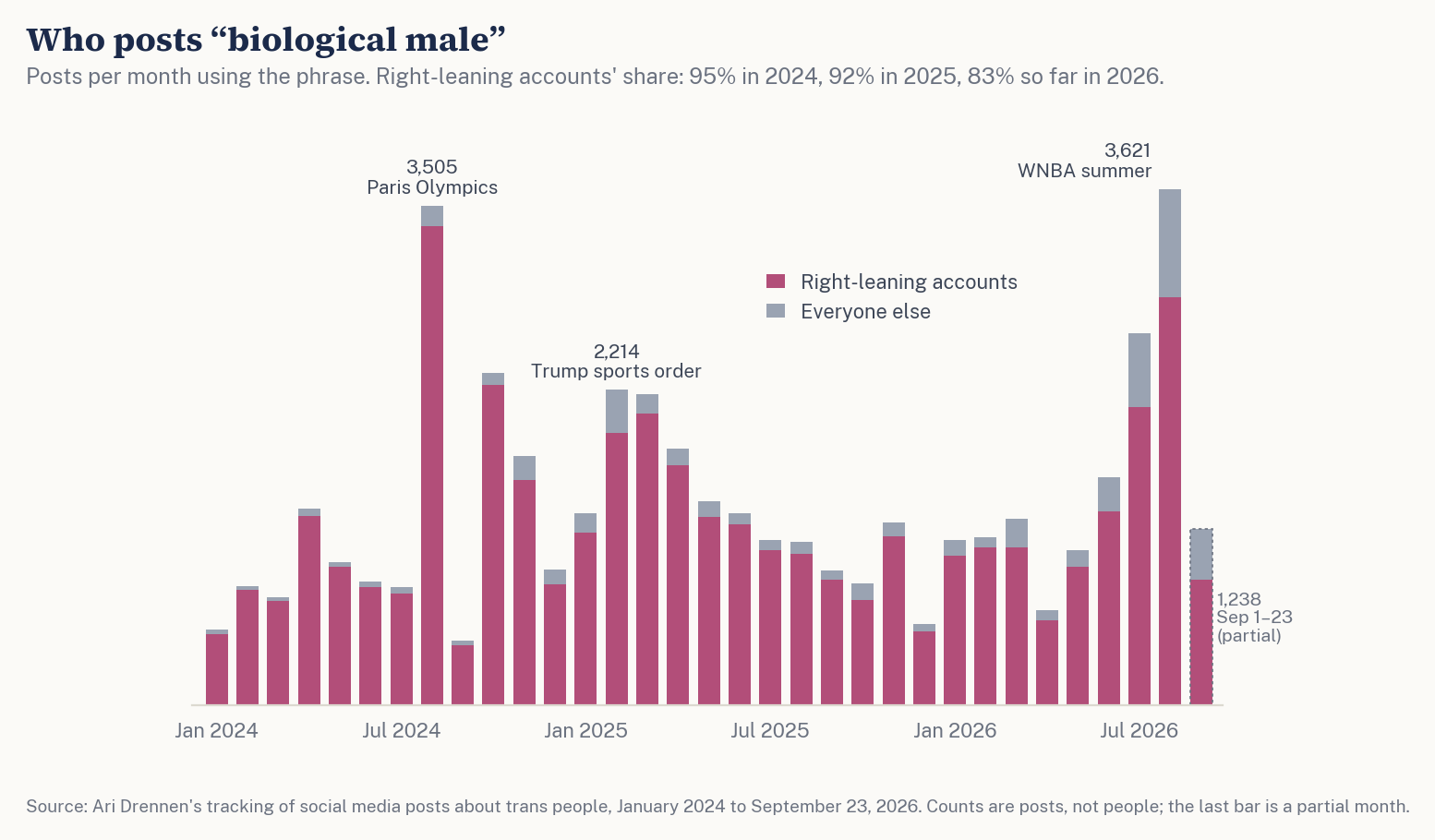
Since January 2024, I’ve logged about 46,000 social media posts that use the phrase, from more than 11,000 accounts, and nine out of ten of those posts came from accounts on the right. That’s a count of posts rather than people, and my tracking only goes back to 2024, but it shows who has been doing the pushing. Fox News and its affiliated accounts, including its sports site OutKick, used the phrase more than 900 times. The most widely shared posts came from right-wing accounts like End Wokeness, Oli London, and Collin Rugg. In a 2024 paper comparing how different outlets refer to trans women, two Stanford linguists found that “biological males” was one of the phrases most closely associated with the right-wing site Breitbart.
The phrase broke out during the Paris Olympics, and the busiest two weeks in my tracking weren’t about a trans woman at all. In August 2024, the Italian boxer Angela Carini quit her Olympic bout against Imane Khelif of Algeria after 46 seconds. Over the two weeks around that fight, I logged about 3,200 posts using the phrase, most of them about the boxing. “Angela Carini is forced to box against a biological male,” End Wokeness posted. Khelif isn’t trans. The president of the International Olympic Committee said she was born a woman, was raised as a woman, carries a woman’s passport, and had competed as a woman for years. The boxing federation that claimed she’d failed a sex test never officially released its results.
The phrase moved into the law, too. In 2016, North Carolina’s bathroom bill defined “biological sex” as whatever was “stated on a person’s birth certificate.” In 2022, two groups called Independent Women’s Voice and the Women’s Liberation Front wrote model legislation they named the Women’s Bill of Rights. In 2023, Kansas passed a version that defines a female as someone whose reproductive system is “developed to produce ova.” Kansas had heard that idea before. In 2002, its supreme court relied on a dictionary that defined the female sex as the one that “produces ova and bears offspring” when it ruled that a trans woman’s marriage was void. The executive order Donald Trump signed on his first day back in office used “biological” or “biologically” fourteen times, counting the title, to define who counts as a woman.
Then institutions that had rejected the phrase started using it. In June 2024, before the Paris Olympics, the IOC gave reporters a list of phrases to avoid, including “biologically male,” because they could be “dehumanising and inaccurate,” according to Fox News. In March of this year, the IOC limited the women’s category at future Olympics to “biological females,” and its president, Kirsty Coventry, said that “it would not be fair for biological males to compete in the female category.” CBS News had already told its staff in January that it would say “biological sex at birth” in its coverage of the Supreme Court’s sports cases, with “no quotes needed.”
My tracking shows the same shift. Right-leaning accounts still post most of it, but a smaller share every year: 95 percent in 2024, 92 percent in 2025, and 83 percent so far this year. Mainstream news outlets used the phrase about 50 times in 2024 and more than 130 times so far this year, sometimes in their own words and sometimes quoting someone else.
Some Democrats have started saying it too. Josh Turek, the Democratic nominee for Senate in Iowa, told The Gazette in July that he doesn’t “believe that biological men should compete against females in sports.” On September 15, I wrote that “biological men” is Ken Paxton’s word and Elon Musk’s, and that we should wait for Turek’s votes in the Senate before deciding he has abandoned us. I still believe that. I’ll also admit what I said the same week: “I personally would have trouble pulling the lever for someone who called me a biological male.” Plenty of trans people online said the same thing more angrily, and I understand why.
The word choices really are different, even among Democrats who’ve taken roughly the same position. When a Fox News anchor asked James Talarico, the Democratic nominee for Senate in Texas, about “biological men competing in women’s sports,” he answered about “trans athletes.” Amy Acton, running for governor of Ohio, said “boys.” The same split shows up in newsrooms. This month, news came out that Virginia’s governor, Abigail Spanberger, had quietly withdrawn a proposed rule that would have kept trans girls off girls’ teams. The public radio station that broke the story wrote about “trans girls.” A Washington TV station owned by Sinclair Broadcast Group wrote, in its own words, that she had ended a rule that “would have prevented biological males from competing in girls’ sports.” Every campaign and newsroom that uses the phrase is choosing a description of us, whether it thinks about that or not.
Meanwhile, the people who pushed the phrase hardest have started dropping the adjective. Two weeks after his first-day order, Trump signed one on sports titled “Keeping Men Out of Women’s Sports,” and it never used the word “biological” in its own voice. In my tracking, right-wing accounts in the first three months of 2024 said some version of “biological male” more than four times as often as they said some version of “men in women’s sports.” By the three months when Trump signed the sports order, the two were close to even.
Why it isn’t accurate
It’s easy to assume the phrase is as old as biology, but it has a history, and the earliest use I could find in a trans woman’s case came in a ruling in her favor. In 1977, the tennis player Renée Richards sued to play in the U.S. Open. A New York judge wrote that he was “totally convinced that there are very few biological males, who are accomplished tennis players, who are also either preoperative or postoperative transsexuals,” and he ruled that the chromosome test used to keep her out was unfair and discriminatory.
By the 2010s, many of the doctors and researchers who studied trans people had settled on “natal male.” The standards of care that the World Professional Association for Transgender Health, or WPATH, published in 2012 wrote about adolescents’ “natal sex.” The American Psychiatric Association’s diagnostic manual said “natal male” until it switched to “individual assigned male at birth” in 2022. Kenneth Zucker and Ray Blanchard, two researchers whom critics of transition cite often, wrote about natal males and natal females in paper after paper.
The clearest example is the Endocrine Society, which writes the guidelines that doctors actually use for hormone therapy. Its 2009 guideline defined a trans woman as “a biological male who identifies as, or desires to be, a member of the female gender.” When the society rewrote the guideline in 2017, it reversed itself. It pointed out that the physical parts of being male or female don’t always line up in the same person, and it concluded that “the terms biological sex and biological male or female are imprecise and should be avoided.” The doctors dropped the phrase in the same years the legislators picked it up.
The people using it now show exactly what the Endocrine Society meant. In July, the WTA, which runs women’s professional tennis, wrote a definition into its new eligibility policy: “‘biological male’ means an individual who, regardless of their legal sex or gender identity, has an SRY gene.” The SRY gene usually sets off male development, but not always, and under that definition many women with XY chromosomes and female-appearing genitalia would count as biological males. That’s the exact example the Endocrine Society used in 2017 to explain why the phrase is imprecise.
The phrase also gets used on people it plainly doesn’t describe. Besides Imane Khelif, people have used it about France’s first lady, Brigitte Macron, who with her husband is suing the conservative commentator Candace Owens for defamation over Owens’s claim that she was born a man. They’ve used it about intersex women, too. Last year, when the conservative magazine City Journal called for genetic testing of female college athletes, I pointed out that it was describing intersex women as “biological men” so that it could ban them. None of these women is a man, and people call them biological males anyway, which tells me the phrase isn’t really a description of anybody’s biology. It’s a way of saying who doesn’t get to count as a woman.
It gets used on us most of all, and the people who use it are usually clear about the tense. In March 2025, Representative Mary Miller of Illinois posted that Sarah McBride, the first openly trans member of Congress, “is a biological man and always will be,” under a name McBride hasn’t used in years. “Always will be” is the part of that sentence I object to, because it’s a claim about McBride’s body today and not about the day she was born.
What’s true about male puberty
It’s true that going through male puberty changes a body in ways that hormones don’t fully undo, and I don’t think our side does itself any favors by pretending otherwise. I wrote here in 2024 that testosterone suppression “does not fully remove the strength advantages gained in male puberty,” and the best research still says so. A 2021 review in the British Journal of Sports Medicine found that trans women’s strength and muscle “remain above those of cisgender women, even after 36 months of hormone therapy.” An Air Force study found that trans women still ran 12 percent faster than cisgender women after two years of hormones.
But the same research shows how much of the body does change. The review found that after four months of hormones, trans women’s hemoglobin, the protein that carries oxygen in the blood, matched cisgender women’s. The Endocrine Society’s goal for our treatment is to keep our hormone levels in the normal range for our gender. A 2024 study in the same journal found that trans women athletes had testosterone levels similar to cisgender women athletes, stronger grip, lower jump height for their weight, and lower aerobic capacity.
This is also why I think allowing doctors and families to make decisions about treatments like puberty blockers remains vital. The Endocrine Society’s guideline advises “starting suppression in early puberty to prevent the irreversible development of undesirable secondary sex characteristics,” which are the same changes the people saying “biological male” keep pointing to. In that 2024 piece, I wrote that if the self-described defenders of women’s sports “were genuinely worried by the threat of athletes who’d gone through male puberty, they’d be working to help trans people get the care they need before puberty begins.” Instead, 26 states have passed laws banning that care for trans kids, according to the Movement Advancement Project, and 48 percent of trans teenagers live in one of them. Those decisions belong with doctors and families, not with politicians who made male puberty the center of their argument and then passed laws ensuring that more trans girls will go through it.
So by the Endocrine Society’s own standard, “biological male” is the wrong description of a trans woman who has been on hormones for a few years. She was born male, and she may have gone through some or all of a male puberty. She now has a female hormone profile and a body that is partly one thing and partly the other. “Natal male” says the first part without denying the rest, and “biological male” only works if you deny it. The same is true in the other direction for trans men, who get called “biological women,” and for nonbinary people, who get called one or the other.
Why not “assigned male at birth”
I know a lot of people in our community would rather say “assigned male at birth,” and I understand why. It’s the phrase our advocates have pushed for years, and most style guides recommend it now. The American Psychological Association’s style guide goes further and says “natal sex” is “considered disparaging” by researchers and by many trans people, because it and “birth sex” “imply that sex is an immutable characteristic without sociocultural influence.” The diagnostic manual made the same switch in 2022, and the LGBTQ media advocacy group GLAAD asks reporters to avoid “biologically male” and “born a man” alike.
But I think “assigned” asks a reader who has never met a trans person to accept something they don’t believe, which is that somebody made a decision about their sex when they were born. Most people think the doctor looked. When we ask them to accept that their sex was assigned, we lose them before we’ve made our argument, and the right is happy to offer them “biological male” instead, a phrase that sounds like plain science. “Natal male” asks them to accept only what they already know, and it doesn’t say anything false about what happened after.
I’m aware of who uses “natal male” today. In my tracking it shows up only about 230 times since 2024, and a lot of those posts come from clinicians and writers who are critical of gender medicine, like the group Genspect and the journalist Benjamin Ryan. I don’t think that makes it their word. It was WPATH’s word and the diagnostic manual’s word before it was theirs, and it means only what it says: the sex a person was observed to be at birth.
Say what’s true
The first judge I can find who used “biological males” in a trans woman’s case used it in a ruling that let her play. Forty-nine years later, after right-wing media spent years pushing it, the phrase is the premise of a Senate hearing. In between, the doctors who treat us decided it was the wrong word.
So if you’re a reporter or a candidate who wants to talk about sports and fairness, you can do it without calling us biological males. Say “trans athletes,” the way Talarico did, or say “natal males” if you mean something specific about puberty. It will cost you nothing except the Republicans’ word for us. And if you’re one of us, I’d ask you to consider that “natal male” is not an insult. It’s the most accurate thing anyone can say about where we started, and it leaves room for everything we’ve become since.
It is mostly about humiliation from the right, not medical or scientific accuracy. But it is a useful shibboleth to know if someone is actually serious about trans issues or not.
It's used, mostly internationally I think, to remind us of what we hate most about ourselves (our male biology), which is cruel, and to signal that the person using the phrase will always see us as men.
It is accurate though. I'm guessing 99% of trans women have XY chromosomes and a body that produced small gametes. We are not intersex nor do we suffer from endocrine disorders that make our sex difficult to determine (the cases the endocrine society is referring to).
We've changed our hormonal profile and some secondary sex characteristics but a cheek swab is still going to reveal our natal sex. Medically, it's important that our doctors know both our biological sex and our gender.